NOTE! This site uses cookies and similar technologies.

If you not change browser settings, you agree to it. Learn more

I understand

Last posts

  • Servizio momentaneamente non disponibile. Leggi i post qui.

Plan Your VisitChildbirth and Childbearing among the Friulian Peasantry Museums without BordersTraces. Ancient landscape in FriuliMonuments and Public ArchitectureSacred architectureThe architect’s housesThe Udine Regional Exhibition of 1903D’Aronco in TurkeyBiography of Raimondo D'AroncoRaimondo D'Aronco_IntroGino Valle. Profession as Continuous ExperimentationLa conoscenza dei nostri monti (Knowledge of Our Mountains)Come un racconto (As a Story)Mind the Gap 2025Trasformazioni. TriesteAntonio Bardino. Il respiro delle piante (Plants' Breath)MIMMO JODICE. THE ENIGMA OF LIGHTEaster Monday at MuseumsMondo Mizuki, Mondo YokaiCastle Lift scheduled closure Thursday 29 May 2025QUI/ALTROVE. Migrazioni d’oggi in Friuli (HERE/ELSEWHERE: Today's Migrations in Friuli)2 June 2025 - Republic Day - Free Admission in All Civic Museums of UdineSilvia Infranco. Trame organicheExhibition in Casa della Confraternita (Free Admission) July - August 2025UEFA Super Cup 2025 - Free and Reduced Tickets to Visit the Civic Museums of UdineImpressionism and Modernism. Monet, Van Gogh, Picasso, Kandinsky, Magritte. Masterpieces from the Kunst Museum WinterthurExhibition in Casa della Confraternita (Free Admission) September 2025Exhibition in Casa della Confraternita (Free Admission) September - October 2025Exhibition in Casa della Confraternita (Free Admission) December 2025OUTSIDERS - THE URBAN-ART PARADOXBuon Compleanno Pimpa! (Happy Birthday, Pimpa!)Il Presepio e l'espressione artistica della NativitàHolidays 2025-2026 Scheduled ClosuresGuido Guidi. Around here. Photographic Projects for the Friuli Venezia Giulia Region, 1985-2014Guido Guidi. With time, 1956-2024Castle Museums - Itinerary: Partial Closure - Friday 27 February 2026ULDERICA DA POZZO. THE TORN DAYSULDERICA DA POZZO. THE TORN DAYSService announcement - CastleMIND THE GAP - From Evidence to Imagination1866 - 2026. Restorations to Rediscover the Art of FreedomFriuli Venezia Giulia Cup 2026 - Free and Reduce Entry Tickets to the Civic MuseumsTEMPORARY CLOSURE OF CASA CAVAZZINI

News

Archduke Franz Ferdinand's Funeral Carriage

Through detailed archival research, the curators of the Civic Museums of Udine have reconstructed the provenance of the funeral carriage which has belonged to the Municipality of Udine since 1931 and is preserved in the storage of the Ethnographic Museum of Friuli. Most likely it is the same carriage that, on 2 July 1914, transported the body of Archduke Franz Ferdinand of Habsburg during the historic homage that the city of Trieste paid to the heir to the Austro-Hungarian throne in the turmoil that paved the way to the outbreak of the First World War after the Archduke's assassination in Sarajevo. The management of the Civic Museums of Udine hopes that the carriage can soon be restored with the contribution of some patrons.

The Hall of the Parliament of Friuli (Castle of Udine)

PARLIAMENT HALL The Parliament Hall (26 x 13 m) is the heart of Udine Castle. Representatives of the aristocracy, clergy and urban communities of the Patria del Friuli, the feudal state led by the Patriarch of Aquileia until the 1420 invasion by troops of the Venetian Republic, which dominated Udine and much of Friuli until 1797, met here periodically. The origins of the Parliament of Friuli date back to the first half of the 13th century. The assembly took place in various locations in the region and had a consultative function, which it maintained after the arrival of the Venetians. The Parliament continued to meet in Udine until 1805, when it was dissolved by Napoleon. To the power of the Parliament the Venetians countered both their direct and indirect military and political control (through the Lieutenants) and the Contadinanza, i.e. the assembly of representatives of the Friulian peasants, whose House stood between via Vittorio Veneto and via Rauscedo and was demolished and rebuilt in 1931 on Piazzale del Castello.

ENG_Astaldi Collection

MARIA LUISA AND SANTE ASTALDI’S COLLECTION Some of the highlights of Casa Cavazzini's collections are represented by the works of art that Maria Luisa Costantini (1899 -1982) and her husband Sante Astaldi (1895 -1982) bequeated to the city of Udine in 1983 in fulfilment of their testamentary wishes. This bequest was related to the Friulian origin of Maria Luisa Astaldi, who was born in Tricesimo but had spent most of her life far from her homeland, of which she had, however, kept an affectionate memory. Astaldis' more than 190 works of art, then, entered the civic collections, integrating the museum's section devoted to 20th-century Italian art. After her marriage to engineer Sante Astaldi, one of the emerging personalities of Italian entrepreneurship in public works after World War II, Maria Luisa Astaldi devoted herself to her studies in Anglistics. A woman of broad and refined culture, a passionate cultural animator, she also nurtured a special interest in art. Starting in the 1930s and in the following decades, the collection grew at a fast pace and prestigious artworks were acquired through private galleries or at major national and international exhibitions of the time. The display follows, through the museum's rooms, the collection's development from the first acquisitions in the 1930s to the last purchases made by the couple in the 1960s.     THE CORTINA EXHIBITION (1941) This room displays the artworks exhibited in August 1941 at the First Exhibition of Contemporary Art Collections held in Cortina d'Ampezzo at the Palazzo Duca d'Aosta.The exhibition, sponsored by the Minister Giuseppe Bottai, aimed to promote Italian collecting of contemporary art. The Astaldi lent Giorgio de Chirico's rare ceramics purchased at the Barbaroux Gallery in Milan in 1941, as well as Gianfilippo Usellini's paintings La Sirena (The Mermaid) and Il ragazzo che disegna (The Drawing Boy), that they had bought at the 1940 Venice Biennale, which are both characterised by a refined symbolism melted into a neo-15thcentury style. Next to them, there are Mario Sironi, with a Female nude (1928) from the Galleria del Milione in Milan, Filippo de Pisis and Ottone Rosai, the latter with the large painting of Giocatori di Toppa (Toppa Players), and Carlo Carrà with Navicello a Venezia (A Navicello Boat in Venice). These artists were already renowned in the national and international art market in wich Maria Luisa Astaldi operated following her collecting interest and demonstrating her appreciation of their modern style.     THE 1940s During the last years of the Second World War (1939-1945), Maria Luisa and Sante Astaldi continued to invest in their art collection, purchasing works by both established and emerging Italian artists. It was during this time that Carlo Carrà's Marina col palo (Marina with a pole) (1943), which the painter exhibited in the same year at the Galleria dello Zodiaco in Rome, entered the collection alongside newartworks by Filippo de Pisis. Alongside these well-known names are those of Giuseppe Capogrossi with Figura in riposo (Resting Figure) (1941) and Franco Gentilini with Adolescente (Adolescent) (1942), a work from the artist's early training between Paris and Rome presented at the Venice Biennale that year. Also worthy of attention is the figure of Renato Birolli, a leading exponent of the Milanese artisticgroup gathered around the magazine Corrente, whose Sogno di Zeno (Zeno's Dream) (1942), a work exhibited by Birolli himself at the Venice Biennale in 1942, was purchased by collectors. A special mentiongoes to the works by Alberto Savinio, documenting the long friendship between the Astaldis and the painter, particularly in the artwork Il protettore dei porti (The Harbour's Protector) (1950), which bears witness to the surreal and fantastic vein that the artist continued to cultivate even in the last years of his life.     THE 1950s During the 1950s, the collection grew in an abstract way. This decade was characterised by a focus on works of art which aimed to integrate and enrich the artistic movements already present in the collection and to record the evolution of the historical Avant-gardes: Pablo Picasso, Georges Braque, Marc Chagall, who, having now reached unattainable market prices, were acquired through prints and lithographs. At the 1954 edition of the Venice Biennale, moreover, the Astaldis bought Ben Nicholson’s Painting (1940). It shows a compositional structure organised on pure geometric abstraction derived from Piet Mondrian's renowned production. Meanwhile, the Astaldis focused olso on figurative works, such as Gino Severini's Natura Morta con Chitarra (Still Life with a Guitar) (1919), which dates back to the painter's Cubist phase.     THE 1960s AND 1970s In the early 1960s, the collection was further enriched with abstract artworks. These Astaldis focused on Anton Zoran Mušič's Cavallini che passano (Trotting Young Horses) (1950) and Ecran naturel (1962), both characterised by a powerful poetic transfiguration between memory and emotion, for which Maria Luisa Astaldi had a strong inclination. Moreover, in the 1960s the Astaldis purchased Giuseppe Santomaso's works directly in the painter's Venetian studio, such as Paesaggio animato (Animated Landscape) (1964), in which colour is no longer a tool but an active pictorial subject and an event that materialises on the surface of the work. The artist, who was an active member of the Gruppo degli Otto (Group of Eight) for which Lionello Venturi had coined the definition of “abstract-concrete painting”, develops in these paintings a language based on the emphasis of its gestural component, as well as on careful study of light, colour and paint.

Meals and banquets in Renaissance in Udine
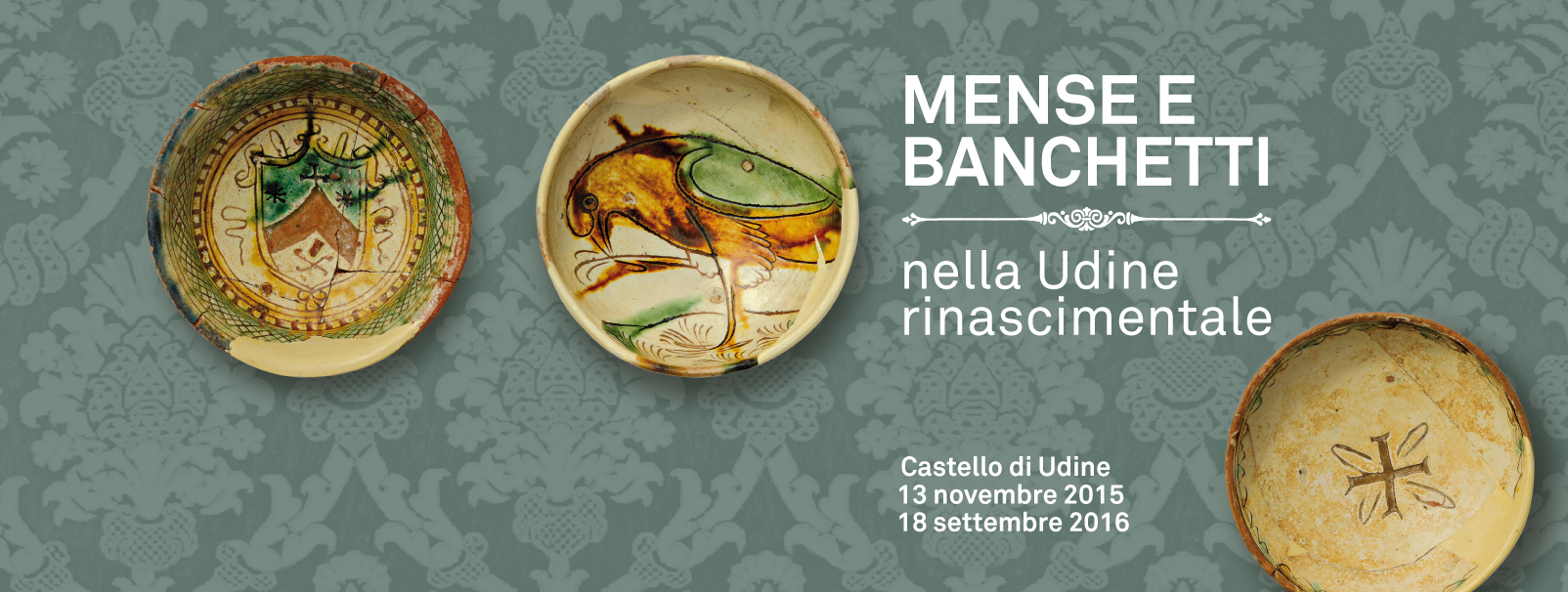
12th November 2015 - 15th January 2017


In the year of the universal exhibition in Milan, dedicated to the theme “Feeding the Planet, Energy for Life”, an itinerary has been created starting from archaeological finds and the rich cultural heritage of the city in order to illustrate the food, books, furnishings and rituals of the Friulian noble families in the 15th and 16th century.


SHORT GUIDE TO THE EXHIBITION


The last supper by Pomponio Amalteo - The new augmented reality app